Lots has happened, and I have fallen into the same trap that many other bloggers fall into – getting busy and neglecting their blogs. If anybody has been checking here and not found anything valuable and new over the past 10 months or so, since I was last active, I apologize.
Over the last 10 months or so, Vermont Law School has been engaged in rolling out a major environmental law program in South China, focused on academic exchanges, training workshops and conferences, and research. We have held 2 major conferences, one in March at VLS, on the state of China’s environmental regulatory system, and one in May at Sun Yat-sen University on energy efficiency and resource use. We have also hosted 3 SYSU exchange students for our environmental law summer program. Furthermore, one faculty from SYSU has already settled in as a visiting scholar for the fall semester. A second will be arriving shortly to commence her fall semester academic residence. Over the summer, we also hosted an environmental law workshop at VLS for a Chinese environmental lawyer and a judge of China’s Supreme People’s Court. And most significantly for me, possibly, I have become the director of the Vermont Law School -- Sun Yat-sen University Partnership for Environmental Law in China. Over the coming month or so, I will try to provide some catch up on the things have happened because there is some really interesting primary information, including some pictures of one of China’s supposed “cancer villages” that might be of great interest.
There are two recent events, however, that are worth noting. One is an August 24 Washington, DC seminar that my VLS colleague Michael Dworkin participated in. The day-long event was organized by the Regulatory Assistance Project with 5 senior officials of China’s State Electric Regulatory Commission. Other participants included a FERC commissioner and current and former utility commission chairs. The seminar addressed total system efficiency to reduce financial and environmental costs, while enhancing reliability. Topics included market rules, transmission calculations, financial incentives, long range resource planning and energy efficiency.
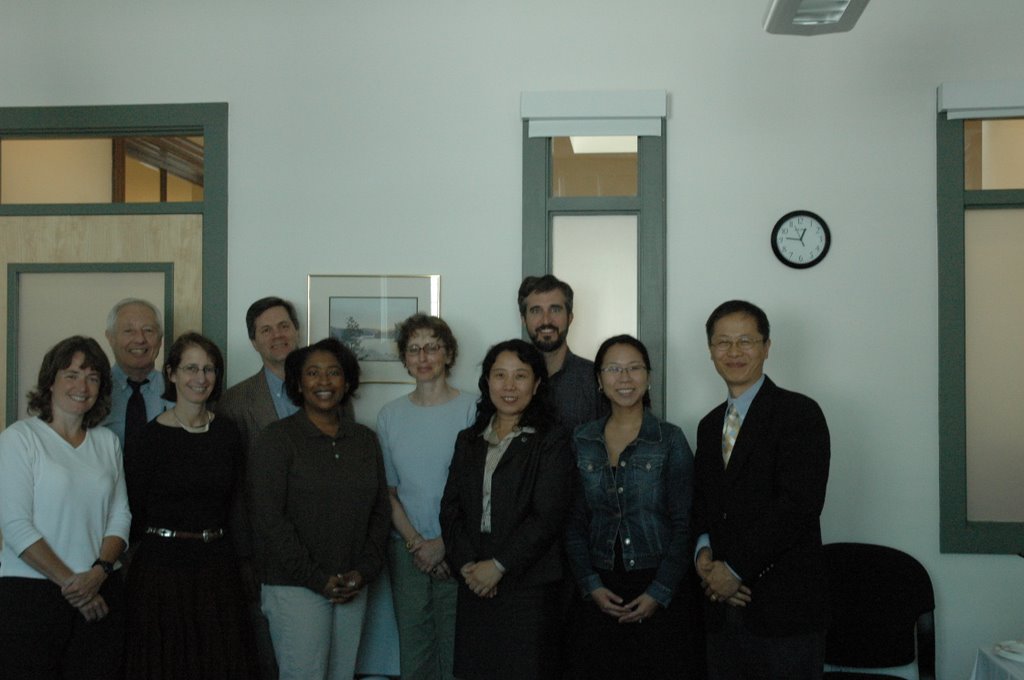
 I recently also just came back from co-sponsoring a roundtable on environmental federalism at SYSU with EPA General Counsel Roger Martella. The roundtable took place on September 3, 2007 and was hosted by Sun Yat-sen University on American environmental federalism and its relevance to China’s central-local relationships in environmental regulation. It featured EPA General Counsel Roger Martella providing EPA’s experience on these issues. Chinese participants were Vice Director Yuan Daoling of the SEPA Southern Regional Supervision Center, Director Wu Hongjie of the Guangdong Province Environmental Protection Bureau Supervision Office (also Zhang Min and Zhuo Yu from Guangdong EPB), and Director Zheng Zewen of the Guangzhou EPB Law and Policy Office. I was also excited to see a number of Guangdong province environmental law professors attend. (Some of the names that I caught were Prof. Du Wanping of Jinan University Law School, Prof. Xing Hong of the Guangdong Business Study College Law School, Prof. Wei Xu and Prof. Gao Min of the South China University of Agriculture Law School, Prof. Hu Danyin of the Guangdong Judicial and Police College, Prof. Cheng Yuyan of the Guangdong Administrative College, and Professors Jiao Bo, Prof. Li Lei, Prof. Li Zhiping, Vice Dean Zhou Linbin, and Prof. Zhang Baozhu of Sun Yat Sen University Law School). Martella was accompanied by Steve Wolfson, a senior attorney in EPA Office of General Counsel and a long-time friend of mine. Kurt Aufderheide and Gloria Ma of the Guangzhou U.S. Consulate attended. Superb translation of the roundtable (of course, since Roger Martella and Steve Wolfson do not speak Chinese) was provided by Jingjing Liu of our program, as assisted by Gloria Ma. In addition, another 15-20 SYSU graduate law students attended the roundtable, including our summer exchange students Ningfei (Samantha) Qin, Cheng (Richard) Li, and Qing (Thomas) Chen.
(I had not met Martella previously, by the way. But he was just a perfectly delightful, inquisitive, and open-minded individuals, and quite a hit with everybody who attended the roundtable. He mentioned to me that he had come to his week-long China trip with his entire family, wife and three kids – a 7-year-old, a 3-year-old, and a 7 month-old baby. The audacity to travel with so many and such young kids all the way to China does deserve respect!)
Martella basically provided a terrific overview of some of EPA’s programs and recent events that have raised environmental federalism issues. While China is a unitary governmental system, unlike the federal system of the United States, the issue had great relevance because there underlying similarities in the challenge of distributing regulatory and enforcement powers between the central and local environmental regulatory offices. Most importantly, with EPA’s assistance, China’s SEPA has in recent years been involved in the creation of a system of regional offices, similar to EPA’s regional offices. EPA’s experience in these issues has therefore been of great interest and importance to such efforts.
For an American-trained environmental lawyer like me, the most interesting information in this roundtable came from the presentations by our Guangdong province colleagues. All of them were local officials. A counterpoint to the central government officials that are the primary sources of information and contacts for US officials on trips such as that of Martella.
SEPA’s Southern Regional Supervision Center was formally created only in June of 2006, though they have been in existence as a research center since at least 2004 or so. There are at least 5 other Regional Supervision Offices. The Southern RSO cover Guangdong, Hunan, Hubei, Guangxi, and Hainan.
Their function is rather ambiguous, as they do not have primary enforcement authority. This was in fact one of the great challenges that Yuan Daoling mentioned to me personally later in making their office more effective. He summarized the functions of their office as: 1) supervision of local and provincial EPB compliance with laws, 2) investigating serious pollution occurrences, 3) coordinating across provincial lines, 4) providing emergency response to serious pollution incidents, 5) accepting cases and participating in enforcement, 6) investigating sources of pollution and supervising construction and compliance with the 3-simultenaities requirement, 7) supervising the conservation of natural resource sites, 8) receiving complaints about cross-provincial pollution, and 9) dealing with any other cases assigned by SEPA. Overall, their primary duties are, however, to supervise the work of provincial and local EPBs, rather than investigating cases and bringing enforcement cases themselves, unless otherwise assigned by SEPA.
The Southern RSO has one director and two vice directors. Yuan joined the Southern RSO from the Hubei EPB. The office has an staff allocation of approximate 65 staff or so, but presently only 15 or so positions have actually been filled. As their most recent work on issues of provincial mediation, emergency response, and enforcement, Yuan mentioned a case of cross-provincial pollution between Fujian and Guangdong province that they were instrumental in resolving, an emergency response to a oil tanker spill in Hunan, and the supervision of an enforcement matter related to a waste electronic recycler at the border of Guangdong and Guangxi province. Curiously, that last case had come to the attention of the Southern RSO via information provided by a Greenpeace investigation.
The Guangdong EPB official, Wu Hongjie, provided some interesting info about his EPB. Their total provincial staff, including provincial level and local level offices, is about 9000 persons, of which about 6000 are administrative staff. Their primary function is to promulgate regulations and policies as well as on-site enforcement. However, of the total staff, less than 2000 are devoted to on-site enforcement. He believed that 2000 was inadequate to the work needed. (This provides an interesting parallel set of numbers to US EPA’s 18000 employees. Guangdong province has about a 100 million population.) Each year, about 6000 cases resulted in fines. The range of fines however, is rather large, as he mentioned to me later. Most of the fines are on the order of 100,000 RMB (about US$15000) or less. Last year, 2006, the largest fine, 1 million RMB (US$150,000), was imposed only once. (I think that I am remembering this correctly.) He acknowledged that such fines were frequently insufficient to deter pollution violations because it might simply be cheaper/economical for a business to pay the fines.
The final official to talk was Zheng Zewen, the Guangzhou EPB Director of Law and Policy. According to him, last year, his office fielded about 18,000 environmental complaints, which was 3% of the national total and 24% of the provincial total. While overall GZ’s environmental quality has improved in recent years, citizen awareness of environmental quality has improved as well, resulting in more complaints. About 87% of the complaints were related to pollution and noise from industry and transportation. Because the laws and litigation are oftentimes not adequate, he mentioned that ADR was a critical tool to resolving such disputes.
The roundtable presentations were a terrific starting point for furthering discussions on these issues, which we will be pursuing in the future.